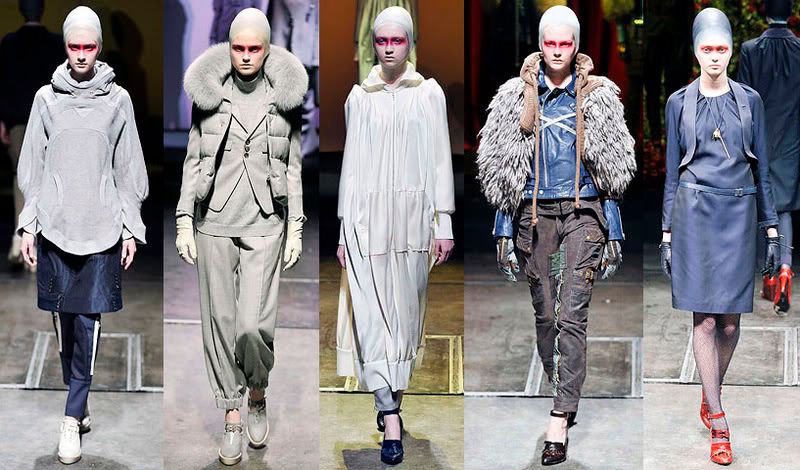
As any great artist should, Jun Takahashi pondered several questions about the state of fashion in his fall collection for Undercover. Each looked seemed to be a walking question mark in search of the meaning of tailoring, sportswear, American streetwear, and of course, the future. I feel like Paris fashion is the most adept at looking at fashion in the future. Where will it be? Who will buy it? Who will design it? Such abstractions may seem pretentious for fashion, but we are what we wear, and why not ask questions, especially when they are so thoughtfully and oddly dazzling at Undercover.
The hooded sweatshirt, unlike any other article of clothing, has had a tremendous effect on how we define youth in the 21st century. In a world run rampant by man and woman-children, post-collegiates who don't want the responsibility of becoming their parents, and major fashion trends aimed at the tween set, the hooded sweatshirt has become a bit of a symbol for those of us who never want to grow up and want to wear something that comfortably reminds of what we would wear to play on the monkey bars. Ellen Page's entire wardrobe in "Juno" consisted of a variety of hoodies and Michael Cera clamored to his during his would-be first time in "Superbad." Grown up fashion magazines, more so men's magazines, tell us how to incorporate them into our work wardrobe. Michael Kors and Juicy Couture, among many other young, trendy labels, have started offering hoodies in cashmere and other luxe fabrics. Takahashi played with the concept of the hoodie in this collection, but here it was exaggerated to the ankles or done in fabrics you wouldn't expect. Puffer jackets, baggy trousers, and bulky sweaters are normally found on your average tenth grader, but here it was chic and something completely new. There's a certain comfort in those clothes that evoke something traditional, but the Daryl Hannah in "Blade Runner" makeup and coneheads on the models looked as if an alien from the distant future transported to a local high school and co-opted the new styles. The outerwear was especially strong with interestingly and intricately layered looking blazers, coats and a baby blue motorcycle jacket immersed under fur shoulders and straps across the bust. For such a futuristic show it never veered into something too austere or avant garde. Pick apart each look and there's something great and uniquely wearable along the way. If you're going to pay the price, you might as well get the greatest bang for you buck.
The idea of sportswear in relation to youth culture was done to death in New York without much precision or mature thought. Here it looks fresh and as if what we've been wanting to see has finally landed.
Wednesday, February 27, 2008
undercover


Thursday, October 25, 2007
in defense: balenciaga spring/summer 2008
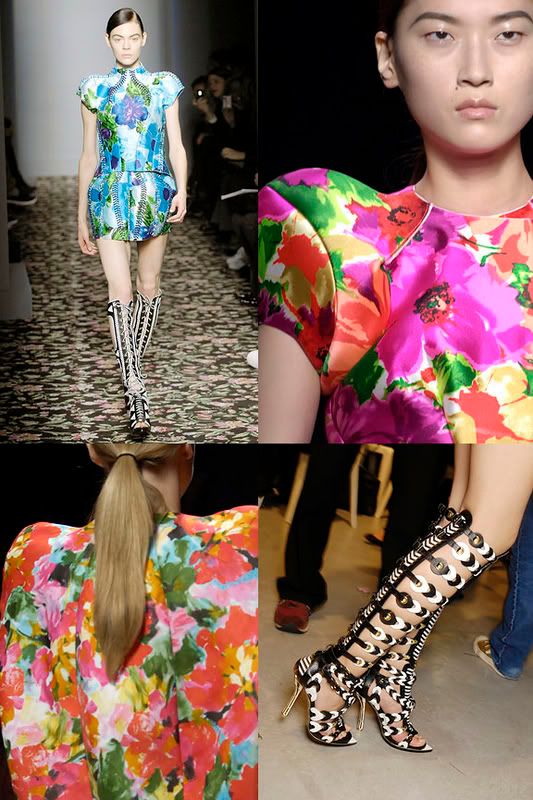
Although I declared Alber Elbaz's full on display of weightlessness and comfort for Lanvin the best of Paris, I was thinking in terms of clothes that express the perfect marriage between fantasy and reality. Those clothes can literally transport your way of thinking but also go with you in a literal sense. That's what I want out of clothes for myself as a man and I think women look undeniably sexy in as well. However, fashion, or Fashion with a capital F, wouldn't exist without those rare collections, or more specifically the presentations, that shoot at us like a driving and propulsive dart and dare us to rethink what we thought was possible. Nicolas Ghesquiere's Spring/Summer 08 collection for Balenciaga still stings in my mind and not for why most women can't wear it but the beauty of the execution and the relevant and prescient ideas imbued in each stitch. I think this was the most controversial and divisive collection of the season, more so than Marc Jacobs, because the grand standing theatrics and self-referential nods to celebritydom that Jacobs let hang over his collection are non-existent in Ghesquiere's collection. It's less coquettish and deconstructed in an obvious way where as there's a dangerous attitude in the clothes that seriously considers age, wearability, power, the future, optimism, and femininity in such wildly arresting ways that you can't help be bowled over by its genius.
Shape so it seems is the thread that agitates the most in the collection. The Pom-pom shoulders, the brisk hemlines, the hard-looking contours that make the models look stiff and unable to move, the emphasis on hips and bust, and all of the other fit and construction techniques Ghesquiere employs are not entirely meant to constrict and scream fuck off to any over size two, small breasted woman but it's a celebration of the form and its relationship to power in the modern world. The shoulders that jump off the figure reminded Ghesquiere's audience that women are just in control as their broad shouldered male counterparts. The Coke bottle silhouette is a welcomed respite to the current trend of sack and baby doll this that infantilize or shame women of their gorgeously natural curves. It's also achingly sensual in all of its close to the body, laced up purr. Ghesquiere wants us to keep thinking that shape is perhaps the most important factor of how or why people wear clothes. We want something to flatter or deemphasize or add, but what about a new shape that demands we think a little more into the future when the idea of luxury in relation to what we wear in the streets is no longer subjected to "wearable pieces." That's what I always find so fascinating in his point of view is his ability to look into the future but keep it contemporary and relevant. The notion of pants, top, and dress are arbitrary, so why not give them, and us, a new set of rules? There's more personality in a look that is less homogenized in its shape and form than the trend everyone is following. We'll go along with any new color, print, or material but to ask us to give up our shape is daunting and almost too authoritative. However, it keeps the idea of fashion going in that every season we can only see some variation on the skirt, blouse, pant, so why not give an exact point of view that is confident and unwavering in its proposition and a little thrilling in its exciting curiosity for newness and forward-thinking.
Perhaps Ghesquiere's greatest challenge will be the prints. The bold and beautiful floral prints that to me communicate an optimism about the world are fresh and alive. The world as we know it is full of shit and pigs but in that we can look at the truth and beauty in things and naturally, nature is a great reference point for an artist to expound upon. The world outside the window can be more attractive than some esoteric film reference or some tired homage to an ancient and influential designer. There have been rumblings about ageism attached to the idea of prints in that older women typically wear them, but would they wear a floral mini? This is a youthful and aggressive collection that shouldn't entirely alienate older women but it's hollow to think that older women prints prefer florals. There was a playfulness in those prints juxtaposed with the hard exterior of their couture inspired armor/outerwear. The pom pom accented shoulders or the mini-suits were harmless in their approach. This is a head on collision with florals and it's completely unashamed in its sweetness.
Ghesquiere has never not surprised or intrigued with his odd takes on futurism and luxury. This is the same man that envisioned $10,000 gold leggings that could have easily passed as costume from "Star Wars" (and that's a compliment). I like that he keeps forging forward so effortlessly and without regard for things that are safe and wearable. I'm not suggesting these clothes will look good on every woman, nor should they in their non-conformist shapes and prints, but you cannot deny Ghesquiere of his deft ability to incite and inspire us all.
*Check back for the rebuttal from Bitch, Please. In point/counterpoint style, the lovely scribe at Bitch, Please will reply with why she didn't like the collection. Take my side for now.