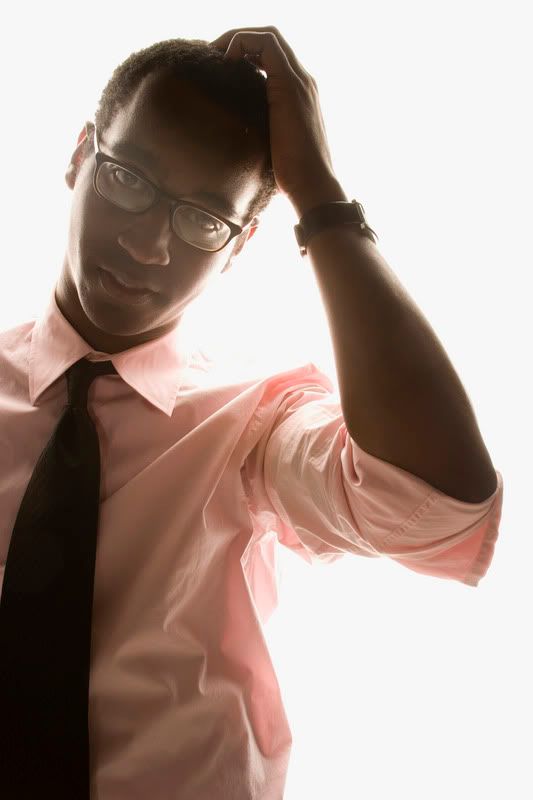
"Gucci by Gucci"
dir., David Lynch
This is pretty but is it wrong that I want more?
Friday, September 28, 2007


Thursday, September 27, 2007
sex and the city
"Hotel Chevalier"
dir., Wes Anderson
2007
A prequel of sorts, Wes Anderson whets our appetite before his next cinematic feast for the eyes, "The Darjeeling Limited", with this simple short film about a man and a woman in a hotel room. I love the mustache on Jason Schwartzman and Natalie Portman has never been so commanding in her on screen sexuality. They play off each other really well although at time it feels like too much of a poured on pastiche and homage to an era of French cinema gone by. I could have easily seen Jean Louis-Tringnant and some pouty-lipped strumpet of the day playing the same roles and engaging in the same banal banter that climaxes in a quiet and sexy pause on a posh hotel balcony. Anderson's trademark wide angle lens, unrelenting esoteric pop music, and slow motion shots are there, but this feels new and more revealing for Anderson namely because of the film's overt but abstracting use of sex. Who knew eroticism and Wes Anderson would be uttered in the same breath?
jil sander
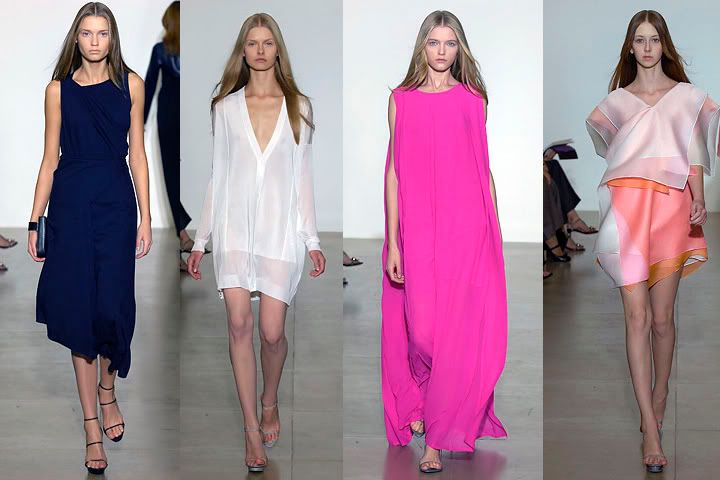
The most necessary item women will need next spring and summer is a reliable pair of underwear. Transparency was a big trend in New York and it resurfaces in Milan where it lends itself to a different take on sensual lightness. The Belgian thinker with a background in menswear, Raf Simons experimented with his own riff on light, movement, and the body at the typically austere Jil Sander.
Over the past handful of seasons since Simons has taken over as chief designer at Jil Sander, he has consistently and expertly crafted a Jil Sander woman that is intelligent, modern, and rigorously chic in the same way Uma Thurman was in "Gattaca" or Tilda Swinton is in any anything. She's a little futuristic, a little provocative in her purity, and a lot evolutionary in her precise and architectural look. The suit and the dress have been Simon's expertise since delving into womenswear (this is only his fifth womenswear show ever) and in this collection he experimented with both pieces that are so central to a woman's wardrobe in a completely refreshing and forward thinking way. Billowy and diaphanous pieces were more present than ever but the same attention to fit and tailoring was not lost in the least. It was lightness on the body done by someone who is curious about things that are perhaps too cerebral for us to understand but he remains very conscientious of who he designs for and that is what keeps us coming back for the simple surprises Simons always has in store.
Simon's appetite for the refined and restrained have been deftly honed ever so slightly each season, but what was fantastic about this show is that he seemed to loosen up a bit and try colors that were new for him and new shapes without losing his personality or what he has already established. Simons worked his usual long and lean shape but added dimension to it by breathing a cloud of tulle around the otherwise structured shape. Volume also showed up in wide-legged pants that were paired with torso elongated tops to give the look a contrast and range. Antenna-thin pants were more narrow than usual but played against those Hammer pants in just the right way. A woman can find her fit somewhere in those pants but be most excited by the colors and interesting play on tops. Shades of creamsicle, shocking pink, and cobalt blue popped more when they were layered in squares of organza or tulle that appeared to be a new variation on the geometric shapes that underscores a Jil Sander collection. Some of the cocktail dresses and maxi dresses looked like Orgami bouquets or naughty blurs of sweet but dirty thoughts. Simons's ability to layer, literally, and place panels of material atop another gives color a different context and offers a brief glimpse of the flesh underneath was neither vulgar or garish. Simon's vision was so relaxed and full of movement that its breeziness and the evocation of something like colored smoke would be perfect for a late night of Champagne on a yacht on the Amalfi Coast.
Body consciousness is redefined at Jil Sander where it's not necessarily clothing that constricts and confines, but draws the eye in to see something more bare and inviting.

Wednesday, September 26, 2007
burberry prorsum
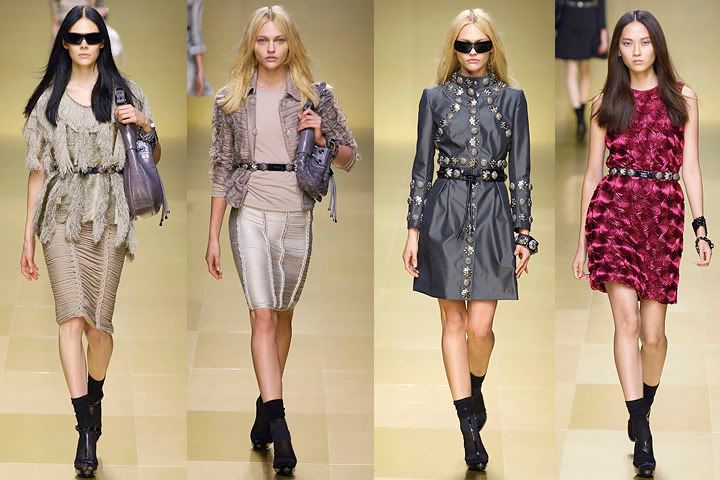
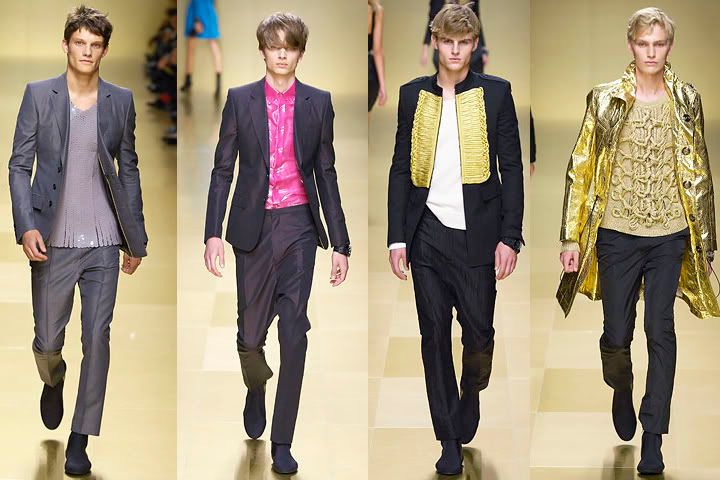
I've always thought Christopher Bailey has a more persuasive personal style than what he typically envisions for Burberry. His suits cut a strong figure, but he's also slightly relaxed and looks comfortable without being too fussy and overdone. And then I see another collection that is bloated with more and more stuff. I don't think one's personal style should be entirely reflective in your design aesthetic but maybe Bailey always feels like he has to over compensate just a little bit to make up for the other wise conservative and traditional brand.
New York taught us that lightness is vital for spring and perhaps Milan has something oppose to that idea because Bailey's look for spring 2008 is hard, heavy, and overt. The neutral palette that largely consisted of every shade of gunmetal works for the chic warrior theme. Studded belts grabbed at the waist and naughty gossamer socks paired themselves with sexy stilettos. Sunglasses made for the Special Ops Forces and the influence of militarism in the form of hard edged jackets or various takes on the trench coat would be perfect for any man or woman on a mission. However, reduction is not one of Bailey's strengths when he veers into this tough babe territory with unnecessary and contrived additions thrown together for one whole look that snowballed into a decidedly underwhelming and out of place collection. Ruching, fringe, lots and lots of studs, lace up accents, and everything else was all too much and too much of an obvious take on luxury. After all these are clothes made for people with a lot of money and according to Bailey they want to wear that fact. I'm also always confused as to what kind of man Bailey has in mind because I don't know too many men, even the most fashionably adventurous, who want sequined tops, gold lame trenches, or Michael Jacksonesque army jackets. Focus and a less is more attitude could lead Bailey into more interesting waters where for spring everything isn't so feigned in its toughness and tarted up in its luxuriousness.
Tuesday, September 25, 2007
first look: into the wild
"Into the Wild"
dir., Sean Penn
2007
When he isn't tending to survivors of Hurricane Katrina, Sean Penn finds the time to fashion a film that Scott Foundas of the The Village Voice hails "unusually soulful" and "poetic"." This looks all fine and dandy, but I couldn't stop staring at Vince Vaughn and his goatee. Is that a reaction to the meida hype that was Vaughnistan?
Monday, September 24, 2007
a new world, a new man
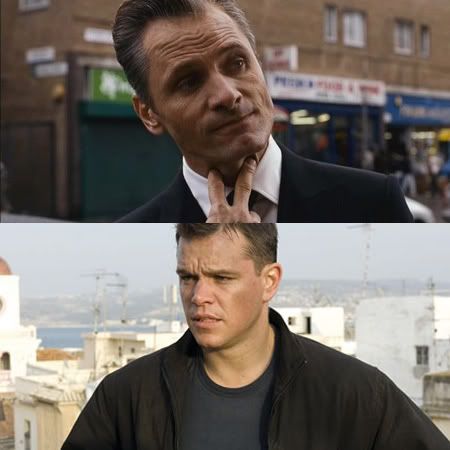
In the new millennium the effects of global immigration, neo-conservative politics that plague and add to the paranoia and fearfulness of modern society, and violence as a threat to an apathetic culture have trickled down to not only shaping our world at large but ushering in a new hero on film. He's a little world weary, abides by a ardent moral and ethical code, and personifies a paradox that exudes a murky duality. Two recent films, Paul Greengrass's "The Bourne Ultimatum" and David Cronenberg's "Eastern Promises" present such men in the form of Jason Bourne (Matt Damon) and Nikolai Luzhin(Viggo Mortensen), who are eternally at odds with their environments and themselves. These two quietly hard boiled specimens exist in a world that is dark and shadowy in its corrupt fueled hierarchy, geographically influenced by a globalized society, and a life is of rich value although they are frequently asked to compromise that fact and dig into that devilish and violent core that typifies the other side of the angelic coin. It's that rabid violence that defines them but they are just as revolted by their power as they are attracted to it. These two creatures could not be any more disparate but the violent tie that binds them is unshakable and revealing of a new desensitized attitude towards violence as portrayed in mainstream media. It's a little more grim and grisly, but could that be our sick desire to watch it or is it simply a mirror effect of what's happening in the crevices of the never ending saga that is the War on Terror?
In the third installment of the Jason Bourne series we find our dashing and brooding hero at the apex of his fight to obtain not only his identity but expose the organization that has controlled him and made him fight for his identity. "The Bourne Ultimatum" informs us that a sect of the Central Intelligence Agency brainwashed "willing" participants in an experiment to transform your well intentioned government agents into a precise and mentally vacant killing machine. They don't ask questions but they are well equipped with the knowledge of how to kill without a trace. Images of Bourne enduring various methods of torture and exploitation call to mind the atrocities of Abu Ghraib. This learned form of sadistic violence backfires when Bourne uses his power not for the intended purposes of reinforcing fear, dominance, and other forms of scare tactics but rather to bring down the root of all evil, white male privilege that exists in powerful positions. C.I.A. Deputy Director Noah Vosen (David Strathairn) and Dr. Albert Hirsch (Albert Finney) are the Gepetto-like masters who have exploited the fragility and apathy of post-9/11 America, where such heinous acts are justifiable if they are tagged with the phrase, "We are trying to protect the American people." Protection fades into harm when America is bamboozled in effort to protect the inept and corrupt that rule and control the Western world. Bourne's violent intuition is a reaction to this idea and thus is not used to oppress but liberate, and for that he is no longer part of the system that binds him.
A fight scene between Bourne and an agent sent to kill him is one of the most well choreographed and frenetic fight scenes I've ever seen. Set in a tightly confined home in Tangiers, Bourne explodes on the agent using his physical strength and instinct, which is quite different for a major fight scene in a studio blockbuster. No shower of bullets or dialogue said with a smirk; this is the primal and violent side of man. Bourne uses his hands or grabs a book or wash cloth to protect himself. Greengass, ever the stylist, propels the action with a cinema vérité inspired handheld camera and natural light. The scene is visceral and culminates in an intense brawl in a dingy bathroom where Bourne grits his teeth like a possessed beast when his hands choke the last breath out of his foe. However, in the next scene Bourne is remorseful and responsible for his actions. He loathes that the only way he knows how to solve a matter of someone infringing upon his life is to destroy and obliterate the opposing force. This humanism imbues the Bourne character with an interesting layer that most plastic and pumped up action heroes are completely removed of. The Bourne films ponders the possibility of whether good is achievable when evil is almost inherently has to be used. It's a daring proposition that also finds a place in the underbelly of the Russian mafia in Cronenberg's "Eastern Promises."
Similar to "The Bourne Ultimatum", a moody pall drifts over the story that is set in a new London experiencing the influx of Russian and other eastern cultures. Nikolai's internal conflict becomes more transparent when Anna (Naomi Watts), a midwife, searches for the identity of a newborn's family. The mother of a child, a deceased teenage prostitute, leaves her diary that leads Anna to Nikolai and the or vory v zakone. He's as steely and stiff as his bouffant of silver hair that rests hard on his head. His role as the chauffeur for the mob makes him present without having to be entirely culpable of the mob's decisions. His boss, the indomitable patriarch, Semyon (Armin Mueller-Stahl) speaks with a voice that sounds like tires grinding on gravel and his intense eyes twinkle with evil that bely his meek old man exterior. It wouldn't be far off to compare the President and his family to Semyon and his boozy fuck up a son, Kirill (Vincent Cassel), where loyalty and tradition are equally important but potentially fatal. The theme of survival is key in the film and particularly in context to the Nikolai's relationship with the family that is coming undone as secrets bubble to the surface and possibly damage their power.
Survival and what that means in the world now is a perfect frame of reference for both films because of their almost back to primitivism points of view. In a world where contemporary politics and violence have turned arbiters of violence into machine gun toting androids, Nikolai's body becomes his means of survival. Tattoos etched across his body explain his history of violence and his eventual transcendence into a morally reprehensible heaven/hell. It's taken too a brutal level when Nikolai's true identity is almost entirely eradicated during a fight in a steamy bathhouse finds Nikolai at his most vulnerable. Devoid of clothes, weaponry, or tricky editing, Nikolai defends himself, naked, against two clothed thugs, suggesting the tension between the savaged and the civilized. It's a thrilling sight to watch a man removed from everything comfortable and contemporary transform into a something so primitive and basic. He's naked, full of instinct, and no one is going to take his precious life. In a Scorsesian way the camera pulls back at the end of the scene to examine the carnage and it's quite a breathtaking blend of blood, bodies, and the hard white floor of the baths.
Whether or not these films are consciously communicating a relevant statement about man and his place in a post-9/11 world, it is clear that they do speak about the body, the necessity of survival, and good versus evil. It's difficult living in this world, but surviving for some is even more difficult. The paradox of man has shifted into something a little more self-reflective and it questions whether or not that ravenous violent bone in the body is natural or learned. Bourne and Nikolai are both products of brainwashing for a group they are hired to protect and serve, but they are also ashamed of their violent streaks. It's their eternal conflict, where their natural self competes with their nurtured self. Violence is a sickness and a love for them. However the greatest and perhaps most disturbing sickness is our love to watch it and enjoy it. But then again that's the beautiful and ugly inside of us all that is at once turned off by it and more importantly joyfully turned on by it.
Saturday, September 22, 2007


Friday, September 21, 2007
first look: southland tales
"Southland Tales"
dir., Richard Kelly
2007
I can't tell if this is a true mess as it was received at Cannes last year, or if this is a fiercely personal condemnation of contemporary American culture. If anything we are treated to a possible career resurgence by the wonderful Cheri Oteri.
If that doesn't tickle your fancy, here is one of my favorite scenes from Kelly's debut conundrum of a film, "Donnie Darko":
There are a lot of things going on in this scene, (character introductions, wide angle lens, 80s references left and right, Drew Barrymore looking pissed) but it's somehow a perfect amalgamation of pop genius at work.
Tuesday, September 18, 2007
new york cares
The fashion world has moved on to London, but I think it's been decided that the blogs will skip it in favor of our anticipation for the big mama and papa show that is Milan and Paris. As a form of closure of New York, I will say that it was exciting to look at as many collections as possible but there were only a handful that stood out and had something really captivating and relevant to say. For me the show of the week that didn't have to rely on tricks, gimmicks, or front row celebrities (save for one truly smoldering Academy Award winner), was without a doubt the clean and confident beauty of Narciso Rodriguez. His design philosophy of functionality and utilitarianism is necessary in a world where we eat, sleep, work, and breath in a bubble that has become increasingly more commanding in its technology, economy, and geo-politics. We need clothes that will adapt with us in all of these cultural circumstances and his clothes have a very modern, no bullshit perspective that will take us anywhere we need to go.
This collection was a startlingly different one for Rodriguez as he showed us new colors, new shapes, and new lines that we haven't seen from him before. With a recent investment from Liz Claiborne and inspiration ranging from ninjas, architect Santiago Calatrava, and a subtle take on transparency, this collection felt full of new life, spirit, and emotion. It's all in the details for Rodriguez when you get closer to see beaded bursts of optimism in the form of tie dyed flowers on the sleeve of a suit jacket or dancing freely on a white dress. The way a collar drops or a shirt is constructed. The seaming and construction are undeniable when you look at all the folds, structure, and heights that he's offering us. The menswear was the strongest he's ever shown with impeccably cut suits that are striking in their natural shoulders, nipped waits, and slim fit.
There is no way you can understand the deft combination of the structure/loose aesthetic that Narciso does so well via pictures. These are clothes that demand movement and as we may soon become nomadic creatures due to the environment, the influx of immigration, and poor leadership in our nation's office, we might need clothes that carry with us and if they are as pure, contemporary, and cool as the collection Rodriguez sent out, I would be more than obliged to wear them.
And with that here is the best spring collection New York had to offer:
The other two standout shows were Marc Jacobs's sex comedy and Preen's soft looseness. Both of these collections had a definite point of view and created something new with their less is more approach (less clothes and more underwear at Marc Jacobs and less structured hardness and more cleavage and exposed skin at Preen) as their central theme. It appeared as if in both shows that the clothes were falling off the models, and I liked that. When the weather warms up, loose clothes are essential, but both of these collections posed the question, what's going on underneath it all?
For menswear I loved Marc by Marc Jacobs, Rag & Bone, and Tony Melillo. Each were youthful, masculine, and wearable, which is what I want out of clothes. They expanded on traditional ideas like shorts, Safari jackets, and scarves. Unwavering in what they had to say, these are the clothes that seem spot-on for next season.
And remember, Milan is only a week away.
videos, duh.
The Go! Team
"Doing It Right"
dir., Good Times
Interpol
"No I In Threesome"
dir., Patrick Daughters
M.I.A.
"Paper Planes"
Live on The Late Show with David Letterman
ENJOY.
Subscribe to:
Comments (Atom)